
Employment and labor laws vary from country to country. This guide is intended to provide the most up to date information available. We will update this guide as needed when changes are made to the laws.
Employment Contracts
Employers are legally required to provide formal written contracts for all employees that include salary/wage, termination terms, job title, etc. The contracts must be written in Luxembourgish and use the Euro currency (EUR).
Working Hours
The standard working week in Luxembourg consists of 8 hours a day and 40 hours a week.
Overtime
All working hours of more than the standard working hours per week are to be paid as overtime and are regulated by employment contract/collective agreements etc. It must also be mutually agreed upon between the employee and the employer and notified to the labor authorities before commencing any overtime working hours.
In general, maximum overtime limits must not exceed 2 hours per day and 8 hours per week.
Overtime hours are paid at a rate of 150% of the regular salary rate of pay.
Work on Sunday is prohibited unless under certain circumstances or for specific sectors; specific compensation should be paid.
Public Holidays
Public holidays falling on a weekend must be compensated to workers by giving a day off in lieu of within 3 months of the holiday.
For the year 2024:
- Jan 1: New Year’s Day (Monday)
- Apr 1: Easter Monday (Monday)
- May 1: Labour Day (Wednesday)
- May 9: Ascension Day (Thursday)
- May 9: Europe Day (Thursday)
- May 20: Whit Monday (Monday)
- Jun 23: National Day (Sunday)
- Aug 15: Assumption Day (Thursday)
- Nov 1: All Saints’ Day (Friday)
- Dec 25: Christmas Day (Wednesday)
- Dec 26: 2nd Day of Christmas (Thursday)
Paid Time Off
Employees receive a minimum of 26 working days of paid leave per year. In addition, certain employees automatically receive additional leave:
- Disabled persons or those who have suffered a work accident- Additional 6 days of leave
- Mining employees- Additional 3 days of leave
- An employee or apprentice who has not received a continuous rest period of 44 hours per week- 1 additional day for every 8 weeks in which the employee doesn’t receive the continuous rest.
Additional paid vacation days may be granted by the collective bargaining agreements or the employers.
Sick Days
Maximum paid sick leave is 26 weeks. Employers pay full salary until the 77th day of sickness leave occurs (whether consecutive or not) over a period of 12 consecutive months. 80% of this pay will be reimbursed by the employers’ mutual scheme insurance. From the 77th day, further leave is paid for by Social Security.
Maternity and Paternity
Maternity Leave
Maternity leave in Luxembourg is 20 weeks and can begin 8 weeks before the expected due date. To be eligible, the woman must have been covered by the mandatory health insurance for at least 6 months within the last 12 months before maternity leave. In addition, the woman must notify their employer at least 12 weeks before the expected due date.
Social insurance pays for maternity leave and cannot be lower than the minimum wage and is capped at 5 times the minimum wage.
Paternity Leave
Paternity leave is clarified within the collective agreement/employment contract of generally up to 10 days. The father must notify their employer at least two months before the leave is intended to be taken. Otherwise, this leave can be reduced to 2 days. In addition, this leave does not have to be taken consecutively and can be taken within two months of the child’s birth.
Paternal Leave
Parental leave in Luxembourg is dependent on the type of contract and the number of hours worked by the employee. To be eligible, the employee must have been registered with social security at the time of the birth/adoption for at least 12 continuous months and work a minimum of 10 hours per week. This leave is unpaid by the employer, but the Children’s Future Fund provides an allowance.
The parental leave can be taken only once per child and before the child reaches the age of 6 (12 for an adopted child). The leave can be taken either in full, partially, or split with the other parent and are based on the number of hours in the employee’s contract/collective agreement:
- For a full-time employee working 40 hours per week- 4-6 months of full-time leave; 8-12 months of part-time leave (50% of regular working hours); 4 periods of 1 month leave within 20 months; 1-2 half days of leave per week within 20 months.
- For a part-time employee working at least 20 hours per week- 4-6 months of full-time leave; 8-12 months of part-time leave (50% of regular working hours)
- For a part-time employee working at least 10 hours per week- 4-6 months of full-time leave.
- Salaried employees- must have worked at least 10 hours per week.

Other Leave
In Luxembourg, special leave is possible for salaried employees who must leave work for personal reasons.
It must be taken when the event takes place and may not be carried over onto the salaried employee’s ordinary leave and must be mutually agreed upon between the employee and the employer prior to any leave taking place.
This special leave depends on the nature of the stated reason (birth, marriage, death, etc.).
Employee Severance and Terminations
Termination Process
The termination process varies according to how the Employment Agreement and Collective Agreement are in place and is based on the type of contract and reason for termination.
For employers with more than 150 employees, a hearing must be conducted before the employee is dismissed. For employees with at least 15 employees, the employer must notify the Economic committee of the dismissal.
Notice Period
Collective agreements may contain provisions on periods of notice. Suppose the periods of notice laid out in the collective agreement differ from the statutory periods of notice. In that case, the employer and the employee must observe the periods of notice laid down in the collective agreement.
The amount of notice is dependent on the length of service:
- The amount of notice is dependent on the length of service.
- For employees with less than five years of service, two months’ notice is required.
- For employees with between five and ten years of service, four months’ notice is required.
- For employees with more than ten years of service, six months’ notice is required.
Notice begins on the 15th of the month if the dismissal letter is provided before or on the 1st of the month. Notice begins on the 1st day of the following month if the letter of dismissal was sent between the 15th and the last day of the month.
It is also possible to pay in lieu of notice.
Severance Pay
Collective agreements may contain provisions on the amount and calculation of severance pay. If the severance pay process laid out in the collective agreement differs, the employer and the employee must observe the process in the collective agreement.
The amount of Severance pay is determined by the length of employment:
- Less than five years- No severance pay
- 5-10 years- 1 months’ severance pay or the notice period can be extended by five months for employers with less than 20 employees
- 10-15 years- 2 months’ severance pay or the notice period can be extended by eight months for employees with less than 20 employees
- 15-20 years- 3 months’ severance pay or the notice period can be extended by nine months for employers with less than 20 employees
- 20-25 years- 6 months’ severance pay or the notice period can be extended by 12 months for employers with less than 20 employees
- 25-30 years- 9 months’ severance pay or the notice period can be extended by 15 months
- 30+ years- 12 months’ severance pay or the notice period can be extended by 18 months.
Probation Period
The minimum probation period in Luxembourg is two weeks and generally is determined by the employee’s salary and qualification status:
- If an employee receives a monthly salary of at least 4,586.12 EUR, the maximum probation period is one year.
- If an employee has a vocational skills certificate or equivalent, the maximum probation period is six months.
- If the employee does not have a vocational skills certificate or equivalent, the maximum probation period is three months.
Payroll Cycle
In Luxembourg, the payroll frequency is generally monthly, although some companies pay weekly. Work between the first and last day of the month/week is typically paid on the last day of the month/week.
The gross monthly minimum wage for over 18-year-old skilled employees is 3,009.88 EUR.
13th Salary
In Luxembourg, it is customary to pay the 13th salary. The 13th salary is the equivalent of one months’ salary and is paid out at the end of the year. It is also common practice for employers to give an additional half months’ salary as well.
Contributions
Employer Payroll Contributions

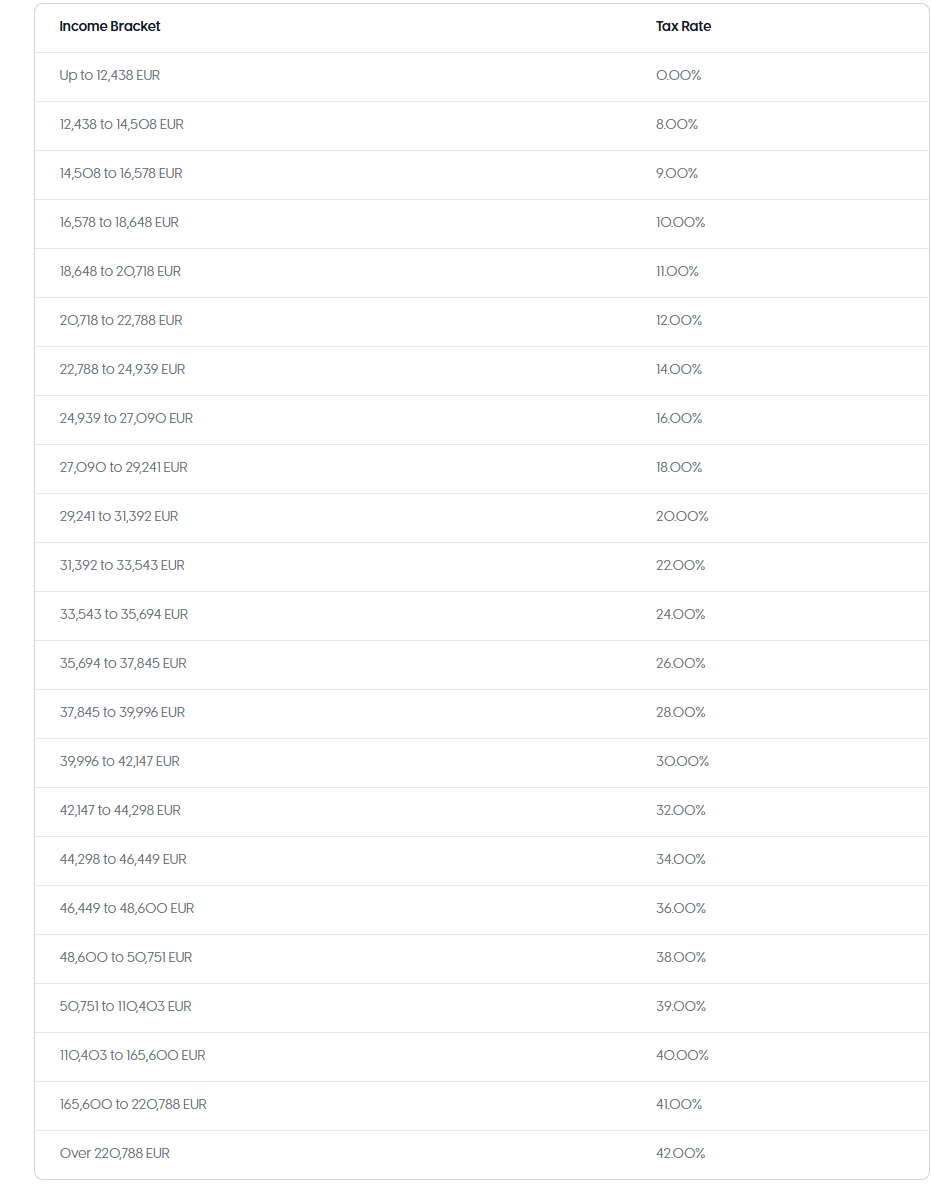
*Luxembourg income tax liability is based on the individual’s personal situation (e.g. family status). For this purpose, three tax classes have been defined: Class 1 for single persons, Class 2 for married persons as well as civil partners (under certain conditions), Class 1a for single persons with children as well as single taxpayers aged at least 65 on 1 January of the tax year.
*These rates of tax are inclusive of a solidarity tax of 7.00% of taxes (9.00% for taxpayers earning more than 150,000 EUR in tax class 1 and 1a or more than 300,000 EUR in tax class 2).
VISA
Citizens of EU and EEA countries and Switzerland do not need a work visa for jobs in Luxembourg. Europeans with Croatian citizenship must still acquire a separate work permit for their first year in Luxembourg.
Anyone who intends to stay longer than 90 days in the country must go to the local Municipal Office in Luxembourg to declare their arrival and intention to stay within the first week of arriving. An address registration certificate is also necessary.
Any foreigner wishing to stay for longer than 90 days in Luxembourg for work purposes must obtain a work visa.
All Luxembourg employers must have gone through the labor market test. Three days before publishing the job opening in any public advertisement, the declaration of the vacant position must be submitted to the National Employment Agency (ADEM). If, after two months, the position has not been filled by an EU national, the employer may proceed with extending the job offer to a third-party national.
For highly qualified employees, the employer is not required to undergo the labor market test. However, the employee will need to declare the open position with ADEM. The employee must have a signed employment contract that is valid for more than one year, can prove they have the qualifications and educational background required to be able to carry out the job duties required. In addition, the salary must be at least 1.5 times the average gross annual salary or 1.2 times the average gross annual salary for certain professions.
For a foreigner to apply for a work visa, the prerequisite is to receive a definite work offer from an employer in Luxembourg before arriving in Luxembourg. This offer/contract of employment must be in accordance with Luxembourgish labor law as it is the premise for approval of a residence permit based on the employment. This does mean that should the foreigner terminate the employment with that employer; the visa will become invalid.
For highly qualified employees: The employer is not required to undergo the labor market test, however, still will need to declare the open position with ADEM. The employee must have a signed employment contract that is valid for more than one year, can prove they have the qualifications and educational background required to be able to carry out the job duties required. In addition, the salary must be at least 1.5 times the average gross annual salary or 1.2 times the average gross annual salary for certain professions.
Remote Work
The legal framework for teleworking outlines that telework is defined as work performed outside the premises of the employer, and not restricted to work from home only.
There is a distinction between regular and occasional teleworking.
Regular Teleworking requires the written agreement of both the employee and the employer outlining the place of telework, the working hours, telework allowance (if any), overtime, benefits in kind, etc. The written agreement may result from an individual agreement with an employee, from a Collective Bargaining Agreement or a company agreement. Employers should provide teleworkers with the necessary equipment to carry out their work.
Occasional teleworking is usually required due to unforeseen circumstances or for a small portion of working time and does not require a written agreement, email will suffice, and the employer is not required to provide work equipment or bear the associated costs.
All remote employees should be able to enjoy the same rights and protections as other employees. This includes all benefits in kind that onsite workers are entitled to but excludes compensations specifically linked with the employee’s presence onsite such as a gym or parking space.
Remote employees have a right to disconnect after working hours and should have the same rights as on-site employees.
VAT
Standard VAT rate – 17%
Intermediary VAT rate – 14%
Reduced VAT rate – 8%
Super Reduced VAT rate – 3%