
Employment and labor laws vary from country to country. This guide is intended to provide the most up to date information available. We will update this guide as needed when changes are made to the laws.
Employment Contracts
Employers are legally required to provide formal written contracts for all employees that include salary/wage, termination terms, job title, etc. The contracts must be written in Spanish and use the Euro currency (EUR).
Working Hours
The standard working week in Spain can be no longer than 40 hours a week (8 hours per day). The typical Spanish working day is from around 8:30-9:00am until approximately 2:00pm followed by a closing for siesta. Operating hours resume from 4:00-5:00pm until around 8:00 pm.
The Spanish Worker’s Statute Royal Decree-Law 8/2019 requires all employees to record their effective daily working hours by clocking in and out when they have a break or at the end of the working day.
Overtime
Overtime regulations may vary according to industry. White collar workers are typically limited to a 40-hour working week. If this is surpassed, compensation of overtime is compulsory (usually at a rate of 175%). The maximum number of overtime hours a single employee can work is 80 additional hours per year. Overtime work hours and payments are strictly regulated following collective agreements. Overtime is voluntary for the worker.
Public Holidays
Workers are entitled to 14 paid public holidays per year including national, regional, and local holidays. Workers should verify dates of their local holidays through their local authority. Days falling on the weekend are lost.
For the year 2024:
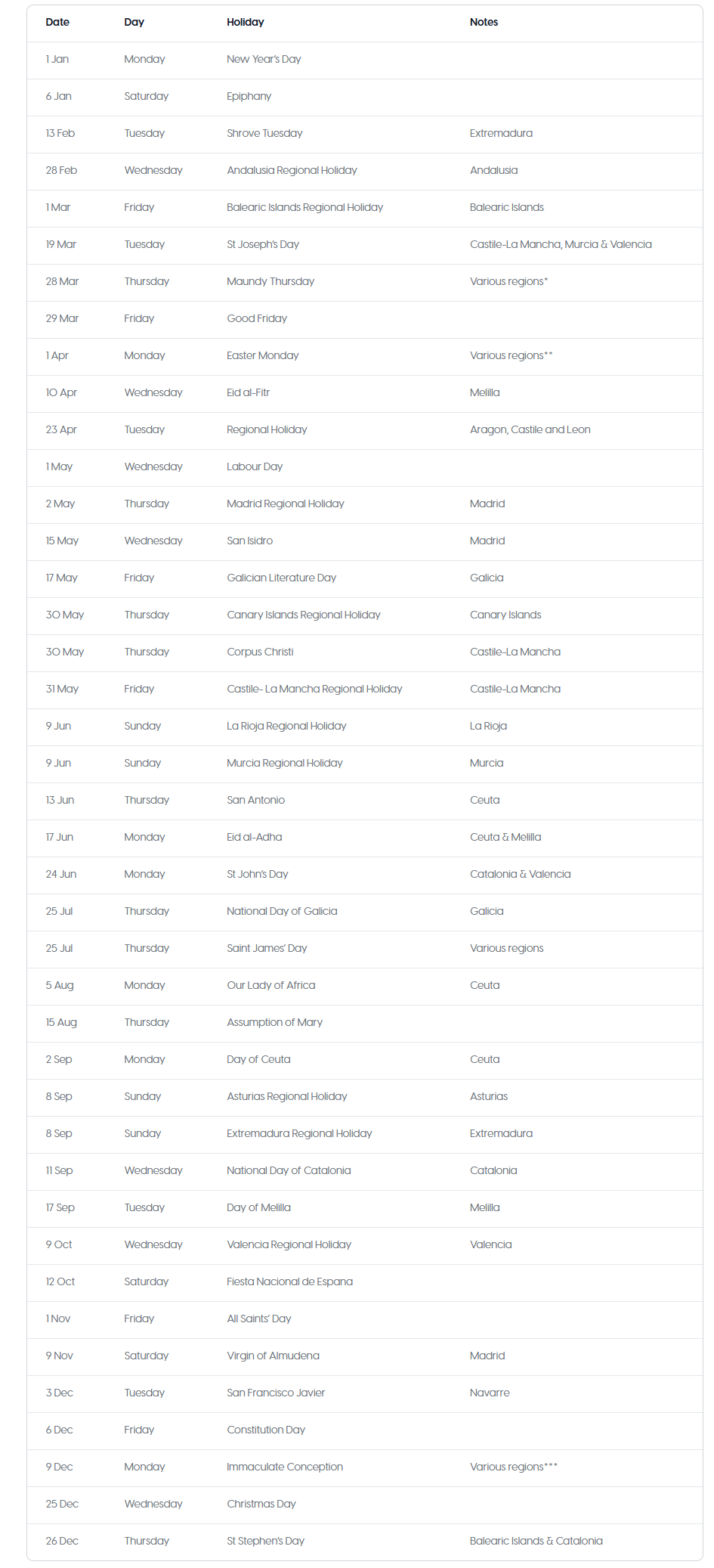
*Andalucía, Aragón, Asturias, Balearic Islands, Canarias, Cantabria, Castilla-La Mancha, Castilla y León, Extremadura, Galicia, Madrid, Murcia, Navarra, País Vasco, La Rioja.
**Balearic Islands, Basque Country, Cantabria, Catalonia, La Rioja, Navarre & Valencia
***Andalusia, Aragon, Asturias, Castile and Leon, Extremadura, Melilla & Murcia
Annual Leave (vacation)
Employees in Spain are entitled to 30 calendar days (22 business days) of paid annual leave in any given year. A Collective Bargaining Agreement may grant additional vacation entitlements.
Workers should use their full vacation balance within the allotted year. Exceptions allowing carryover are in place where leave could not be used due to justifiable reasons such as temporary incapacity to work which permits these vacation days to be used at the end of the period of disability, even if the calendar year has ended, for up to 18 months after the end of the year in which they originated.
Sick Days
In cases of sick leave due to common illness or non-work-related injury, employees must provide a medical certificate and will be entitled to the following salary payments:
- Day 1-3 of incapacity = unpaid (3 days)
- Day 4–20 of incapacity = 60% of the salary calculation base* (12 days)
- Day 21 & over of incapacity = paid at a rate of 75% of the salary calculation base* (up to a period of 18 months depending on INSS approval)
*Calculation base is the result of dividing the amount of the worker’s contribution basis (the monthly gross salary but capped at an annual maximum amount on which the Social Security rates are levied; for 2023 the cap is 4,495.50 EUR per month) corresponding to the month before the illness by the number of days to which this contribution applies (this divider will actually be 30 days, if the employee receives a fixed monthly salary).
The Employer covers the cost of sick leave until day 15, from the 16th day the employer continues to make the salary payment but can reclaim it from the Social Security Administration (INSS). A Collective Bargaining Agreement might provide enhanced terms to the above sickness entitlements. With effect from 1st April 2023, the National Social Security Institute (INSS) will send medical sick leave reports for temporary incapacity directly electronically to companies, via the “INSS EMPRESAS” filing mechanism on the RED system.
Maternity Leave
A pregnant employee is entitled to 16 weeks of maternity leave, with the potential to increase to 18 weeks in the event of a complicated delivery or for multiple births.
The 16 weeks of maternity leave consist of two periods:
- Compulsory leave for the first six weeks after the birth
- Remaining leave for the additional 10 weeks of a full absence, or 20 weeks of half-day absences, which may be taken any time up to one year later (with 15 days’ notice)
It is also common to take two weeks of breastfeeding leave after the end of the maternity leave. The maternity pay is managed and paid by the Social Security System Health Insurance Fund. The Social Security benefits are paid to employees on maternity leave calculated as a monthly benefit equal to 100% of the salary, up to the maximum base of 4,495.50 EUR per month.
In the case of disability of a child, an adopted child, or a foster care child, employees on maternity leave are entitled to have two additional weeks of leave.
All pregnant women are entitled to healthcare before, during and after the birth, and must visit the healthcare center with their Sistema Nacional de Salud (National Health Service) user’s card to receive them.
Paternity Leave
Fathers who have paid Social Security contributions for a minimum of 180 working days within the past 7 years or 360 total days in his entire professional life, are entitled to 16 weeks of paid paternity leave (extended to 18 weeks for multiple births). The first 6 weeks leave after the birth are compulsory and must be taken as time off. The remaining 10 weeks (or 20 weeks of half-day absences) can be taken from the end of the 6 weeks until the child turns one year old.
The Paternity pay is managed and paid by the Social Security System, calculated as a monthly benefit equal to 100% of the salary, up to the maximum base of 4,495.50 EUR per month. During this period, the employer is still liable to contribute to certain taxes that pertain to the salary payments. For same-sex couples, both parents are entitled to paid leave. One applies for paternity leave benefits and the other for maternity leave benefits. However, in order to qualify for paid benefits, it is essential that each parent has the correct legal association with the child.
Parental Leave
Employees are entitled to take unpaid parental leave (providing at least 10 days notice), up until the minor child reaches eight years of age and for up to eight weeks continuously or over several blocks.
Other Leave
Workers are entitled to additional special leave (unless the Collective Bargaining Agreement outlines a different policy) for the following:
- Care Leave: Employees are entitled to up to two years of unpaid leave to assist a seriously ill household or family member.
- Family Nursing & Hospitalisation Leave: Employees are entitled to 5 days of paid leave to care for family members and second degree relatives with a serious illness, hospitalisation or surgery.
- Bereavement Leave: Employees are entitled to 2 days of paid leave (4 days if travel is required) for the death of a family member.
- House Moving Leave: If an employee is moving to a new home, they are entitled to 1 day’s leave.
- Marriage Leave: Employees are entitled to up to 15 days’ leave in case of marriage.
- Judicial Leave: Employees are entitled to paid leave to perform their public or personal obligations (in court) if necessary. A written notice is required.
- Union Leave: When performing trade union or workers’ representative activities, employees can be granted additional leave, as established by law or collective agreement.
Employee Severance and Terminations
Termination Process
The termination process varies according to the employment agreement and collective agreement in place and is based on the type of contract and reason for termination.
Notice Period
Notice periods in Spain are generally set at a minimum of 15 calendar days. Alternatively, employers can utilize payment in lieu of notice. During the probation period no notice needs to be given.
Severance Pay
Fair individual redundancy: 20 days or 33 days of salary pay per year of service, up to 12 months. For collective layoffs, this is usually increased through collective consultations. Fair disciplinary dismissal: no severance.
Probation Period
Probation or trial periods are generally set within the Collective Bargaining Agreement; with the common minimum of 2 or 3 months for non-high qualified workers and a maximum of 6 months for high categorized workers.
Payroll Cycle
In Spain, the payroll frequency is monthly and paid typically on the last day of the month.
13th Salary
13th and 14th month salary payments are mandatory in Spain. This is usually paid within the 12 monthly salary payments.
In Spain, minimum wages are fixed per industry sector in the collective bargaining agreements; however, in general, the minimum wage used in Spain is 1,080 EUR per month in 14 payments.
The minimum wage of temporary employees, as well as seasonal workers who work for the same company for less than 120 days, cannot be less than 51.15 EUR per day.
Contributions
Employer Payroll Contributions


Tax Relief for Expats (Beckham Law)
The Beckham law provides a tax advantage to foreigners in Spain. Expats are eligible to pay a flat fee of 24% on the income they earn within Spain. The law applies to all employees who reside abroad but wish to work in Spain, allowing them to pay taxes as non-residents for the first 6 years of their stay. To qualify for the Beckham law tax relief, the worker should not reside in Spain for 5 years prior to obtaining the tax benefit. The expatriation or relocation for the purpose of obtaining tax benefits under the Beckham Law may occur either in the first year of application or in the previous year.
The application needs to be submitted within 6 months starting from the date of the inscription in the Social Security Administration as an employee for the Spanish company; a late register will result in an automatic denial. To Apply, the worker should submit Model 149 to the Spanish tax agency (“Hacienda”).
VISA
A work visa allows foreigners to enter, stay, and work in Spain. An employee must apply for the work visa in person, and applications must have been submitted at least 90 days before travel.
If the position is to fill a highly skilled role or the candidate is a non-EU citizen, employers need to apply for a work visa from the Ministry of Labor prior to appointment. The embassy or consulate will then issue the work and residence visa after the Ministry of Labor has approved the application.
In Spain, there is a specific work visa for seasonal workers, but obtaining a visa is the same. However, seasonal workers must prove that they have accommodations arranged, travel costs are taken care of, and that they will be returning to their respective country once the job has been completed.
Remote Work
Remote working set ups have become very common in Spain in recent years. It is recommended to give all homebased employees a Home Working allowance of at least €50 (and up to €100 per month is common depending on the job requirements) Euros per month. This applies when home working 30% or more of the time. Certain Sectors and Collective Bargaining Agreements make this allowance a mandatory requirement e.g. the banking sector. This allowance is taxable.
VAT
The standard VAT rate in Spain is 21%.